2. GM-MCMC and large-scale computing on Fugaku
Development of an efficient Markov chain Monte Carlo framework and its application on the supercomputer Fugaku.
Background
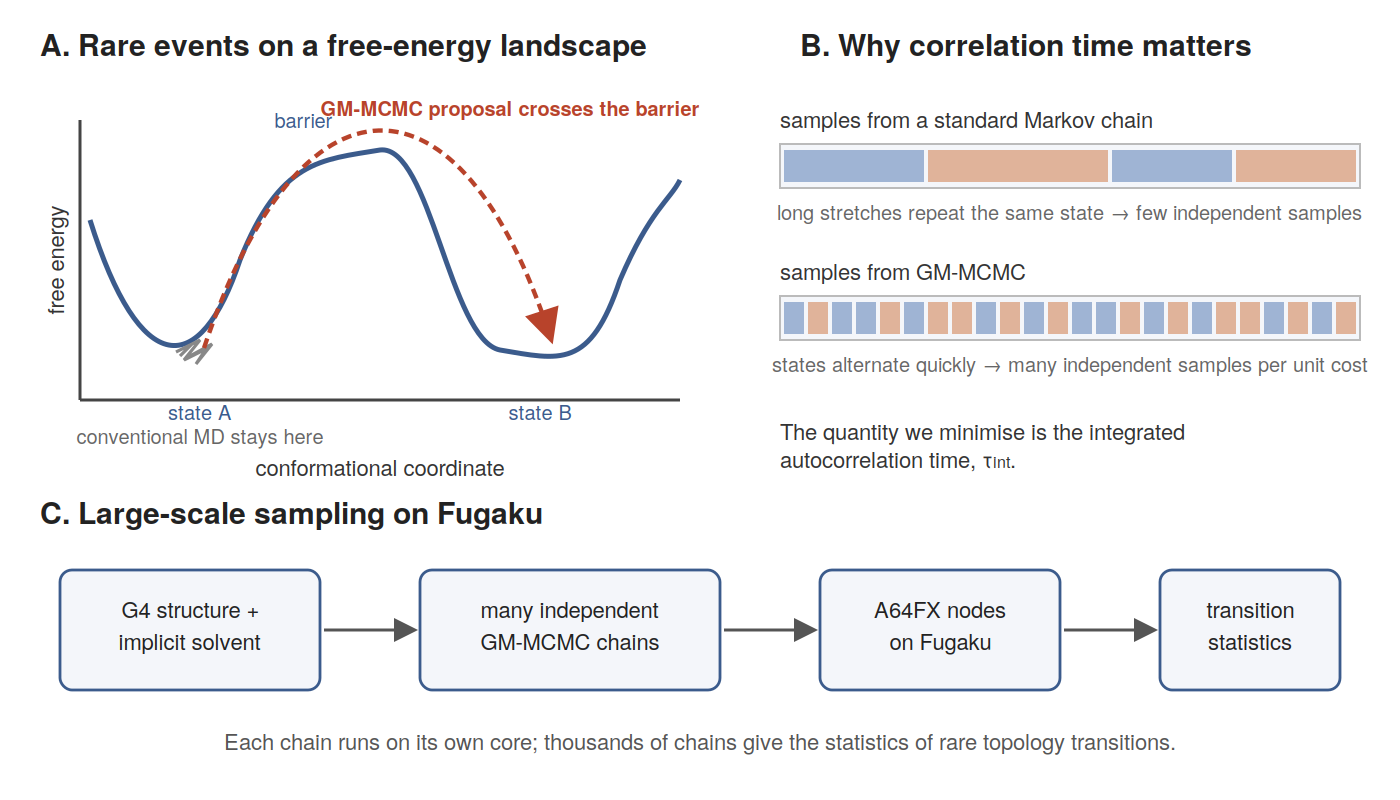
Many important events in biomolecules—the unfolding of a structure, the switch from one topology to another—are rare events: the molecule spends almost all of its time in one stable state and only occasionally crosses a high free-energy barrier. A conventional molecular dynamics simulation follows the true motion of the atoms step by step, so it may run for an impractically long time before a single barrier crossing is observed. Markov chain Monte Carlo (MCMC) methods offer an alternative: rather than following the physical motion, they generate a sequence of configurations that is statistically equivalent to the equilibrium distribution, and they are free to propose large moves.
What we study
- The GM-MCMC framework. Together with Dr. Takafumi Iwaki we develop a Markov chain Monte Carlo framework whose proposals are designed so that successive samples decorrelate quickly. The key quantity is the integrated autocorrelation time τint: the smaller it is, the more statistically independent samples are obtained per unit of computation.
- Performance on Fugaku. We have evaluated the method on the A64FX processors of the supercomputer Fugaku and are applying it to large-scale sampling of G-quadruplex topology transitions, running many independent chains in parallel to collect the statistics of rare transitions.
- Genome organization. The same computational resources are used for coarse-grained studies of how chromatin folds inside the nucleus.
Why it matters
An efficient sampler turns problems that are out of reach for direct simulation—such as estimating the relative populations of G4 topologies and the rates of interconversion—into problems that can be solved with a well-defined statistical error. The method is general and not restricted to nucleic acids.
Selected publications
- GM-MCMC: J. Chem. Inf. Model., 2026. DOI: 10.1021/acs.jcim.6c00196