3. Evolutionary genomics of aging and longevity
Cross-phylum comparison of aging-related proteins and theoretical models of bet-hedging and aging.
Background
Animal lifespans range from a few weeks to more than a century. Aging is not simply “wear and tear”; it is a trait that has been shaped by natural selection, and different lineages have evolved very different rates of aging. Two complementary approaches are used in our laboratory: comparing the genomes of species with different lifespans, and building mathematical models of how aging can evolve.
What we study
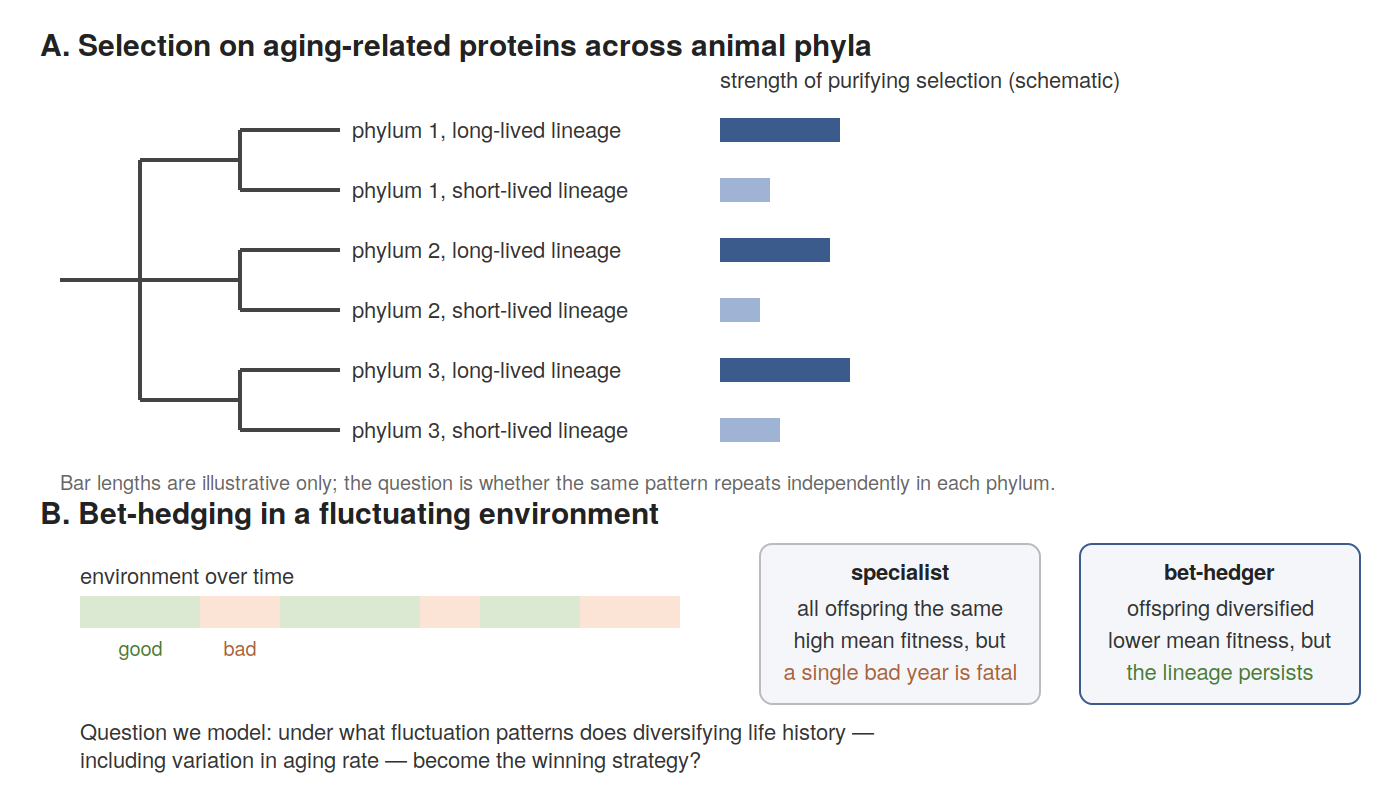
- Purifying selection on aging-related proteins. We compare the sequences of proteins implicated in aging across multiple animal phyla and ask whether long-lived lineages show a stronger removal of harmful mutations (purifying selection) than short-lived ones. Because each phylum provides an independent comparison, a pattern that recurs across phyla is much stronger evidence than a pattern seen in one group alone.
- Bet-hedging and the evolution of aging. When the environment fluctuates unpredictably, a population can do better in the long run by diversifying the traits of its offspring, even at the cost of a lower average fitness. We use mathematical models to ask under what fluctuation patterns such bet-hedging—including variation in the rate of aging—becomes the winning strategy.
Methods
Phylogenetic comparative analysis of protein-coding sequences, estimation of selection regimes, and stochastic population models analysed both analytically and by simulation.
Manuscripts on both topics are currently under review; publication details will be added once they are accepted.