4. Bayesian statistics and causal inference on clinical data
Bayesian networks and causal inference applied to clinical databases in collaboration with clinical departments.
Background
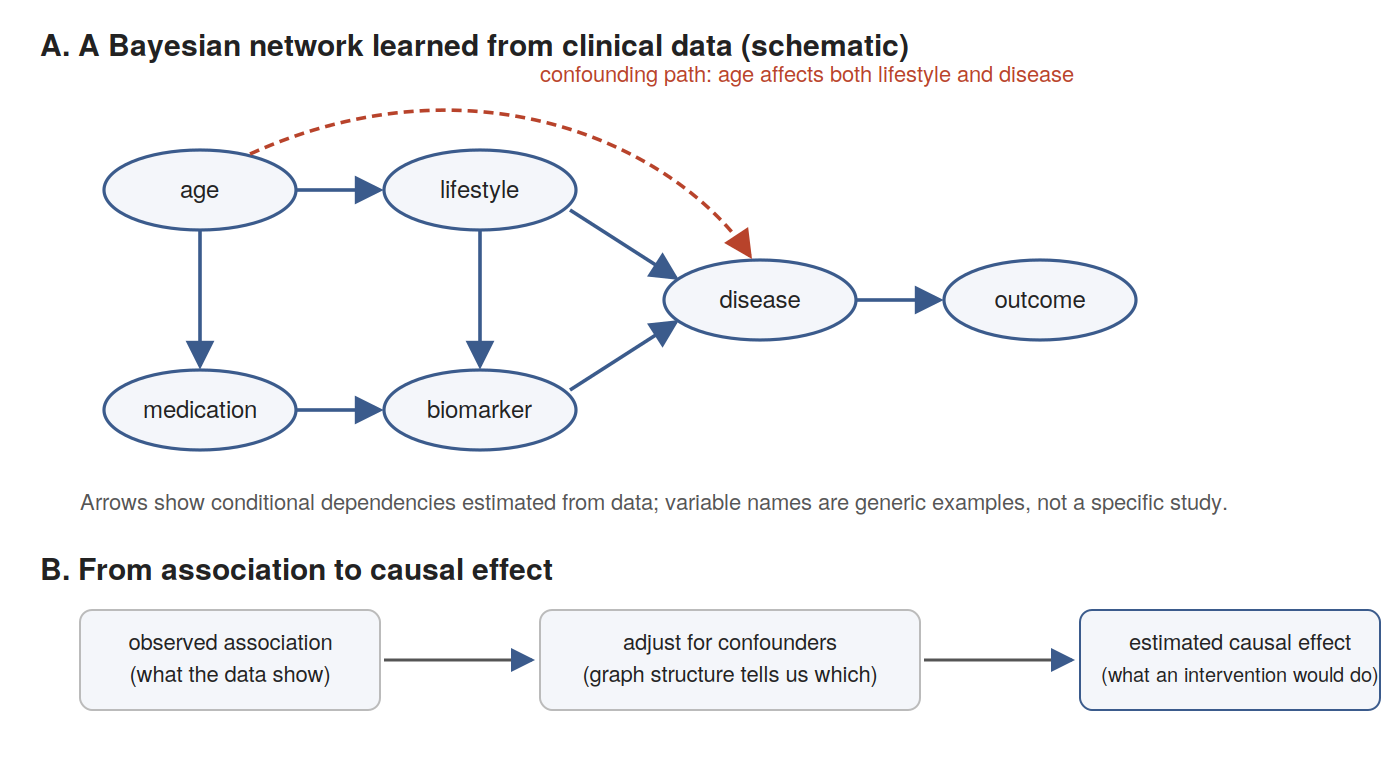
Clinical databases record many variables for each patient—age, lifestyle, medications, laboratory values, diagnoses and outcomes—and these variables influence one another in complicated ways. Two variables can be correlated without one causing the other; a third variable (a confounder) may be driving both. Distinguishing association from causation is essential if the analysis is to inform medical decisions.
What we study
- Structure learning with Bayesian networks. A Bayesian network encodes the conditional dependencies among variables as a directed acyclic graph. We estimate such graphs from clinical data, which gives an interpretable picture of how risk factors, biomarkers and outcomes are connected.
- Causal inference. Given a graph, causal inference methods identify which variables must be adjusted for so that the estimated effect of one variable on another is not distorted by confounding. We apply these methods to questions raised by our clinical collaborators.
- Collaboration with clinical departments. As a basic-science department within the Faculty of Medicine, we work with clinical departments of Oita University on studies that use large-scale medical databases.
Why a physics department does this
Bayesian statistics, graphical models and Monte Carlo sampling are the same mathematical tools we use in molecular simulation; applying them to clinical data is a natural extension of our expertise.