1. Nucleic acid dynamics and G-quadruplexes
Molecular dynamics of DNA/RNA, K⁺ binding and topology transitions of G-quadruplexes, and genome-wide selection on G4-forming sequences.
Background
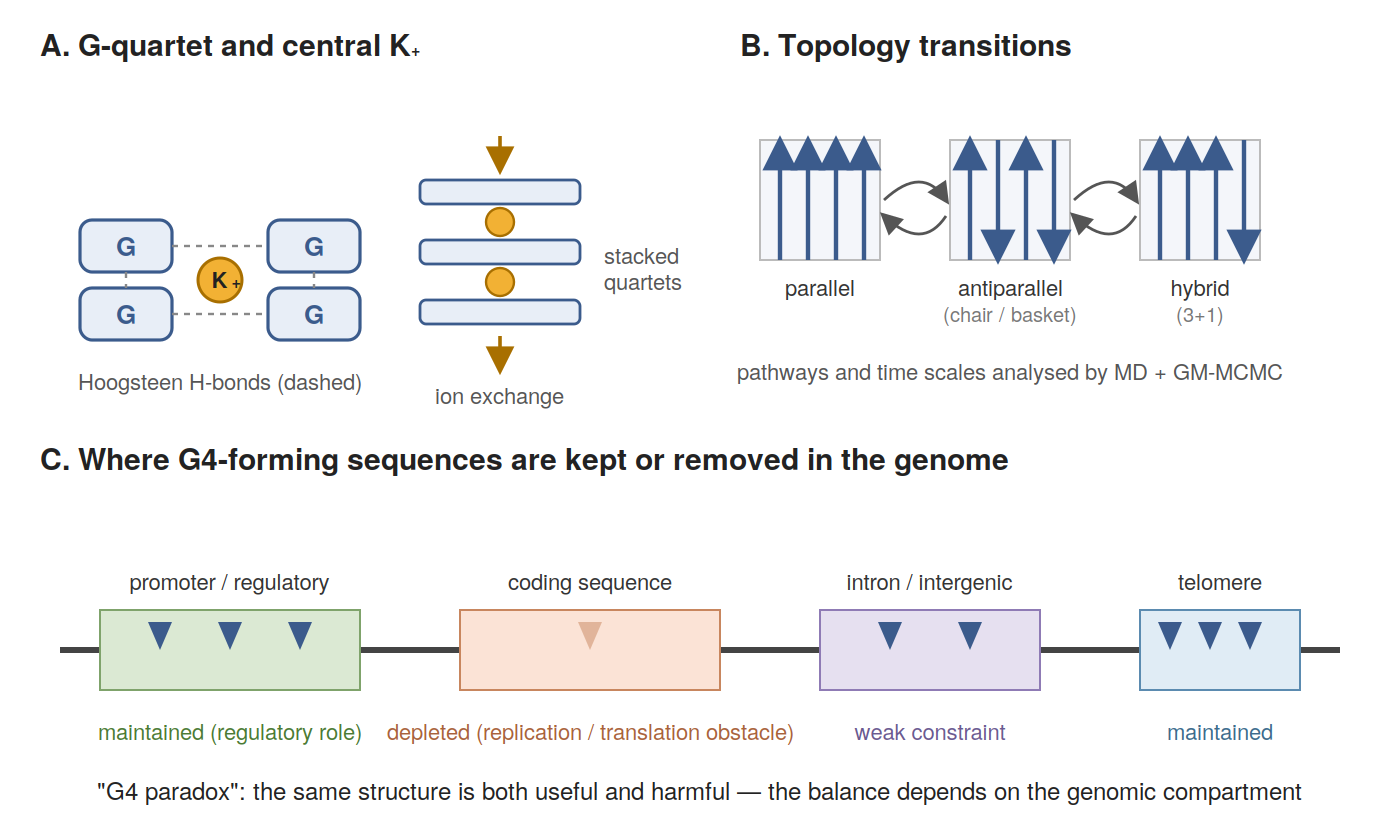
DNA and RNA do not exist only as the familiar double helix. Guanine-rich sequences can fold into a four-stranded structure called a G-quadruplex (G4), in which four guanines form a planar “G-quartet” held together by Hoogsteen hydrogen bonds, and several quartets stack on top of one another around a channel of monovalent cations, usually K+. G4-forming sequences are found in telomeres, gene promoters, untranslated regions of mRNA and viral genomes, and they are thought to take part in the regulation of transcription, replication and translation.
What we study
- Counter-ion kinetics. Using molecular dynamics simulations we follow how K+ ions enter, move within and leave the central channel, and how this ion exchange is coupled to the stability of the folded structure.
- Topology transitions. The same sequence can adopt chair, basket, hybrid or parallel folds. We investigate the pathways and time scales of transitions between these topologies. Because such transitions are rare on the time scale of ordinary simulations, we combine molecular dynamics with our own sampling method, GM-MCMC, and analyse the resulting trajectories with statistical tools such as transfer entropy and committor analysis to identify which structural motions drive the transition.
- Genome-wide selection on G4 sequences. A G4 can be useful (as a regulatory switch) and harmful (as an obstacle to the replication or translation machinery) at the same time. We compare the distribution of G4-forming sequences across genomes, from coronaviruses to eukaryotic kingdoms, and ask how natural selection resolves this “G4 paradox” differently in different genomic compartments—promoters, coding sequences, introns, telomeres.
- Ion- and protein-induced conformational changes. Our long-standing interest in how multivalent ions and proteins reshape DNA and RNA continues alongside the G4 work.
Methods
All-atom molecular dynamics with explicit and implicit solvent, Markov chain Monte Carlo sampling, information-theoretic analysis of trajectories, and comparative genomics of G4-forming motifs across large sequence collections.
Selected publications
- DNA counter-ion kinetics: J. Chem. Phys. 164 (19), 2026. DOI: 10.1063/5.0333184
- The G4 paradox in coronavirus genomes: Virus Research, 2026. DOI: 10.1016/j.virusres.2026.199692
- Compartment-dependent selection on G4 sequences across eukaryotic kingdoms: bioRxiv preprint, 2026.