



News 2025
◆学会(日本免疫学会)
| 2025年12月10日-12日 |
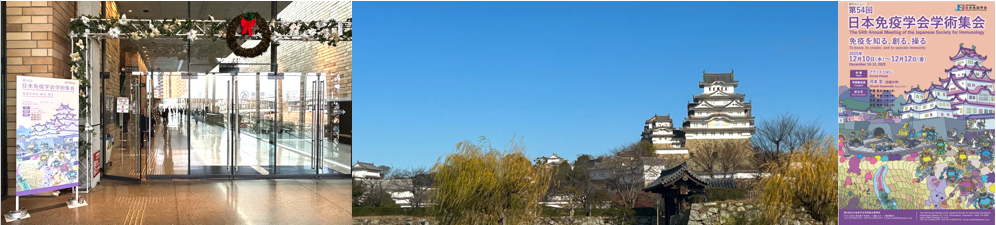 |
| 2025年12月10–12日 日本免疫学会に参加しました 12月10日から12日にかけて、姫路市(アクリエひめじ)で開催された日本免疫学会学術集会に、佐知さん、梅木君と参加しました。 本学会では、本年度のノーベル生理学・医学賞を受賞された坂口志文先生によるビデオ講演が行われました。坂口先生がスウェーデン・ストックホルムにてノーベル賞授賞式に臨まれている最中の開催となり、会場では大きな関心を集めました。 また、共同研究を行っているタイ・チュラロンコーン大学のパラガ教授の研究グループをはじめ、大阪大学の茂呂教授の研究グループ、京都大学の椛島教授の研究グループとの交流の機会があり、最新の研究成果や今後の展望について活発な意見交換を行いました。 最新の免疫学研究に触れるとともに、研究ネットワークをさらに深める、大変有意義な学会参加となりました。 |
| Annual Meeting JSI 2025 (December 10–12, Himeji) From December 10 to 12, we attended the Annual Meeting of the Japanese Society for Immunology, held at ACREA Himeji in Himeji City, together with Dr. Sachi and Mr. Umeki. During the meeting, a video lecture by Professor Shimon Sakaguchi, the recipient of the 2025 Nobel Prize in Physiology or Medicine, was presented. As Professor Sakaguchi was attending the Nobel Prize Award Ceremony in Stockholm, Sweden at the same time, his lecture attracted significant attention from the audience. We also had the opportunity to interact with several research groups, including our collaborators from Professor Paraga’s group at Chulalongkorn University in Thailand, Professor Moro’s group at Osaka University, and Professor Kabashima’s group at Kyoto University. Through these exchanges, we actively discussed the latest research findings and future directions in immunology. Overall, the meeting provided a valuable opportunity to engage with cutting-edge immunological research while further strengthening our research network. |
| Nozomi Sachi: The CCL9-CCR1 axis as an intrinsic regulatory pathway suppressing neuroinflammation in EAE Chemokines are key regulators of immune cell migration in inflammation and host defense. In multiple sclerosis (MS), IL-17-producing Th17 cells infiltrate the central nervous system (CNS), yet the mechanisms regulating their entry remain unclear. We found that RANK stimulation induced a CC chemokine, CCL9, in astrocytes. It has been reported that CCL9 is expressed in the follicle-associated epithelium and the dome regions of mouse Peyer's patches. However, its expression and function in the CNS remain unclear. We generated CCL9-deficient (KO) mice using CRISPR/Cas9 and induced experimental autoimmune encephalomyelitis (EAE), a murine MS model. CCL9 KO mice developed more severe disease, with increased CNS infiltration and elevated IL-17, IFN-γ, and GM-CSF expression. Th17.1 (IL-17+IFN-γ+) cells were increased in the brain, while Treg frequencies |
|
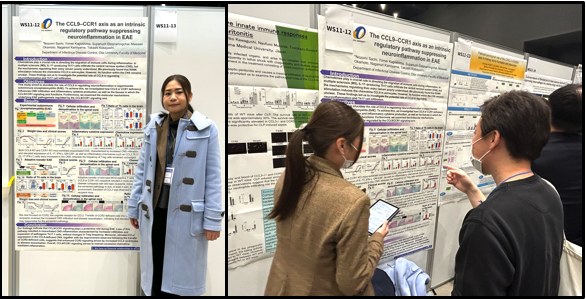 |
remained unchanged, suggesting a Treg-independent anti-inflammatory role of CCL9. CCR1 KO mice, lacking the cognate receptor for CCL9, showed similarly exacerbated EAE, implicating the CCL9-CCR1 axis as a potential intrinsic suppressor of neuroinflammation. To examine whether this disease exacerbation is due to environmental rather than T cell-intrinsic factors, we are currently performing adoptive transfer experiments using MOG-reactive T cells from WT donors into WT, CCL9 KO, or CCR1 KO recipients. Further detailed analyses are required to understand the molecular mechanisms underlying the immunosuppressive effect of the CCL9-CCR1 pathway. |
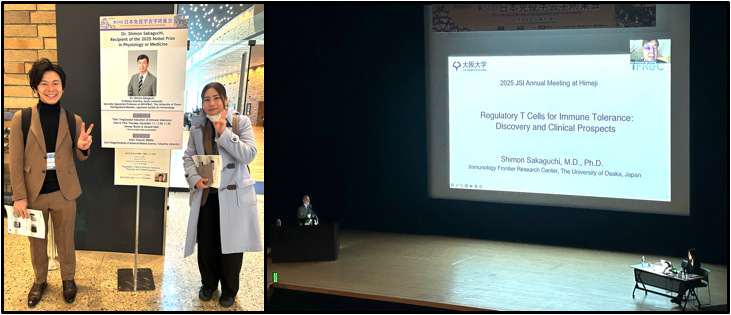
| 坂口志文先生によるビデオ講演「Regulatory T cells for Immune Tolerance: Discovery and Clinical Prospects」を聴講しました。 講演では、制御性T細胞(Regulatory T cells:Treg細胞)発見の経緯から、その免疫寛容における本質的な役割や特徴について、歴史的背景を交えながら解説がなされました。さらに、近年明らかになってきたTreg細胞の分子機構や多様性に関する最新の知見が紹介されるとともに、自己免疫疾患、移植医療、がん免疫などへの今後の臨床応用の可能性についても展望が示されました。 免疫学の基礎から臨床への橋渡しを実感できる、非常に示唆に富んだ講演でした。 |
 |
 |
|
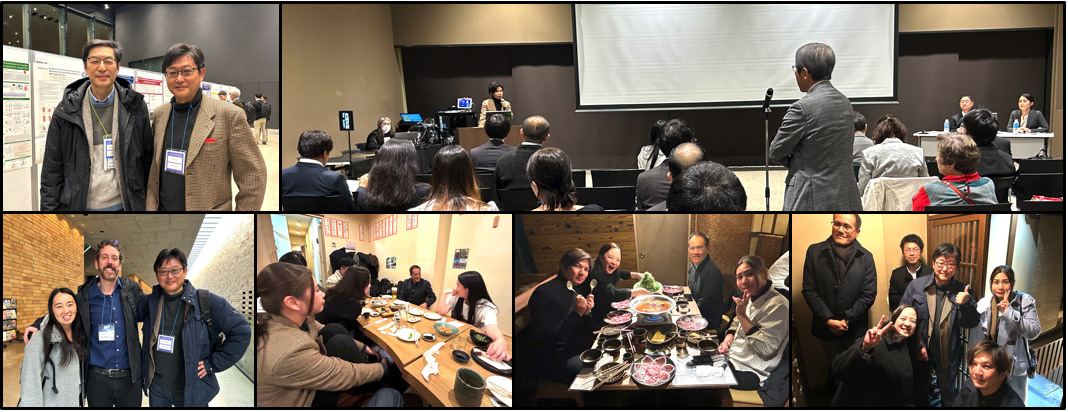
| 恩師の吉村昭彦先生(東京理科大学)との再会(左上)。小安重夫先生から鋭い質問を受ける古賀君(阪大)(右上)。茂呂和世先生(阪大)、Dr. Ari Molofsky(UCSF)と(左下)。茂呂研主催の懇親会は30名ほどで大賑わい(左下)、パラガ教授グループとの懇親会(右下)ではじっくり研究情報を交換しました。 | |