



News 2026
◆表彰 中塚医学賞
2026年7月8日 |
第16回 中塚医学賞に神山長慶准教授が選出されました(7月8日) 2026年7月8日、第16回中塚医学賞(大分大学医学部研究表彰)の表彰式および受賞者セミナーが、医学部臨床中講義室にて開催されました。 中塚医学賞は、大分医科大学初代学長・中塚正行氏の名を冠し、医学部における若手研究者の研究活動の活性化と発展を目的として設けられた、伝統ある研究表彰です。本年度は、生命科学・医学専門分野から5名、看護学専門分野から1名の計6名の研究者が表彰され、その一人として当講座の神山長慶准教授が選出されました。 神山准教授の受賞は今回で2回目となります。受賞研究の課題名は「ジカウイルスはアストロサイトにおいてT細胞誘引性ケモカインを誘導し、実験的自己免疫性脳脊髄炎(EAE)を増悪化させる」です。 ジカウイルス(ZIKV)は、胎児の小頭症やギラン・バレー症候群との関連が報告されています。また、因果関係は明らかになっていないものの、多発性硬化症(MS)患者の脳からZIKVが検出されたことから、ZIKV感染とMSとの関連にも関心が寄せられています。 本研究では、MSの動物モデルである実験的自己免疫性脳脊髄炎(EAE)を用いて、ZIKV感染が中枢神経系の炎症病態に及ぼす影響を解析しました。その結果、ZIKVに感染したマウスではEAEの症状が増悪し、中枢神経系における脱髄が顕著に認められました。さらに、ZIKV感染によってアストロサイトにおけるCCR2のリガンドとなるケモカインの発現が増加し、病原性T細胞の中枢神経系への浸潤が促進されることを明らかにしました。この反応にはTRAF6シグナルが関与しており、CCR2阻害剤であるプロパゲルマニウムを投与することで、ZIKVによるEAEの増悪が抑制されました。 これらの成果は、ZIKV感染によって引き起こされる神経病態の進展において、TRAF6シグナルを介したケモカイン産生とT細胞浸潤が重要な役割を果たすことを示すものであり、ウイルス感染と神経炎症性疾患との関連を理解する上で重要な知見となりました。 表彰式に続いて行われた受賞者セミナーでは、出張のため欠席した神山准教授からビデオメッセージが寄せられました。ビデオメッセージでは、今回の受賞に対する喜びと、これまで研究を支えてくださった関係者への感謝の気持ちが述べられました。今回の受賞を励みとして、神山准教授の今後さらなる研究の発展と活躍が期待されます。 |
July 8, 2026: Dr. Naganori Kamiyama Receives the 16th Nakatsuka Medical Award On July 8, 2026, the award ceremony and awardee seminar for the 16th Nakatsuka Medical Award (Oita University School of Medicine Research Awards) were held at the Clinical Lecture Room of the School of Medicine. The Nakatsuka Medical Award is a prestigious research award established in honor of Dr. Masayuki Nakatsuka, the first president of Oita Medical University. The award aims to promote and advance research activities among young researchers at the School of Medicine. This year, a total of six researchers—five in the fields of life sciences and medicine and one in nursing science—were recognized. Among them was Associate Professor Nagayoshi Kamiyama from the Department of Infectious Disease Control. This marks the second time that Associate Professor Kamiyama has received the Nakatsuka Medical Award. His award-winning research project is entitled “Zika Virus Induces T Cell-Attracting Chemokines in Astrocytes and Exacerbates Experimental Autoimmune Encephalomyelitis (EAE).” Zika virus (ZIKV) has been associated with fetal microcephaly and Guillain–Barré syndrome. Although a causal relationship has not yet been established, ZIKV has also been detected in the brains of patients with multiple sclerosis (MS), raising interest in a possible link between ZIKV infection and MS. In this study, Associate Professor Kamiyama investigated the effects of ZIKV infection on inflammatory pathology in the central nervous system using experimental autoimmune encephalomyelitis (EAE), an animal model of MS. The study showed that ZIKV-infected mice developed exacerbated EAE symptoms accompanied by significant demyelination in the central nervous system. Furthermore, ZIKV infection increased the expression of chemokines that serve as ligands for CCR2 in astrocytes, thereby promoting the infiltration of pathogenic T cells into the central nervous system. This response was dependent on TRAF6 signaling, and treatment with propagermanium, a CCR2 inhibitor, suppressed ZIKV-induced exacerbation of EAE. These findings demonstrate that chemokine production and T cell infiltration mediated by TRAF6 signaling play important roles in the progression of neurological pathology caused by ZIKV infection. The study provides important insights into the relationship between viral infection and neuroinflammatory diseases. Although Associate Professor Kamiyama was unable to attend the ceremony and awardee seminar due to an off-campus engagement, he sent a video message expressing his joy at receiving the award and his gratitude to everyone who has supported his research. We look forward to Associate Professor Kamiyama’s continued success and further development of his research, inspired by this recognition. |
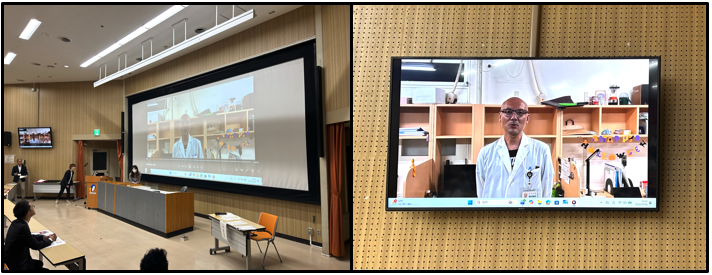 |
神山先生は出張のため表彰式は欠席。受賞の喜びと感謝の気持ちをビデオメッセージで送りました。 Dr. Kamiyama was unable to attend the award ceremony due to an off-campus engagement. He sent a video message expressing his joy at receiving the award and his sincere gratitude to everyone who has supported his research. |